
The AI landscape changed dramatically in early 2026. What once felt like a debate between models now feels like a generational shift. Comparing Claude Opus 4.6 to GPT-4 is no longer useful. Consequently, the real competition today is Claude Opus 4.6 vs GPT-5, especially GPT-5.2 and GPT-5.3 Codex.
Both models represent the highest tier of modern AI. However, they optimize for very different priorities. This guide explains the current 2026 standards, verified capabilities, and best practices so you can choose the right model with confidence.
Why the Comparison Shifted in 2026
OpenAI retired GPT-4 class models in early 2026. At the same time, Anthropic released Claude Opus 4.6 with major architectural upgrades. Consequently, industry focus moved toward reasoning depth, agentic behavior, and long-term context handling.
Today, the choice is no longer about who writes better text. Instead, it depends on whether you need a systematic enterprise agent or a scientific and creative powerhouse.
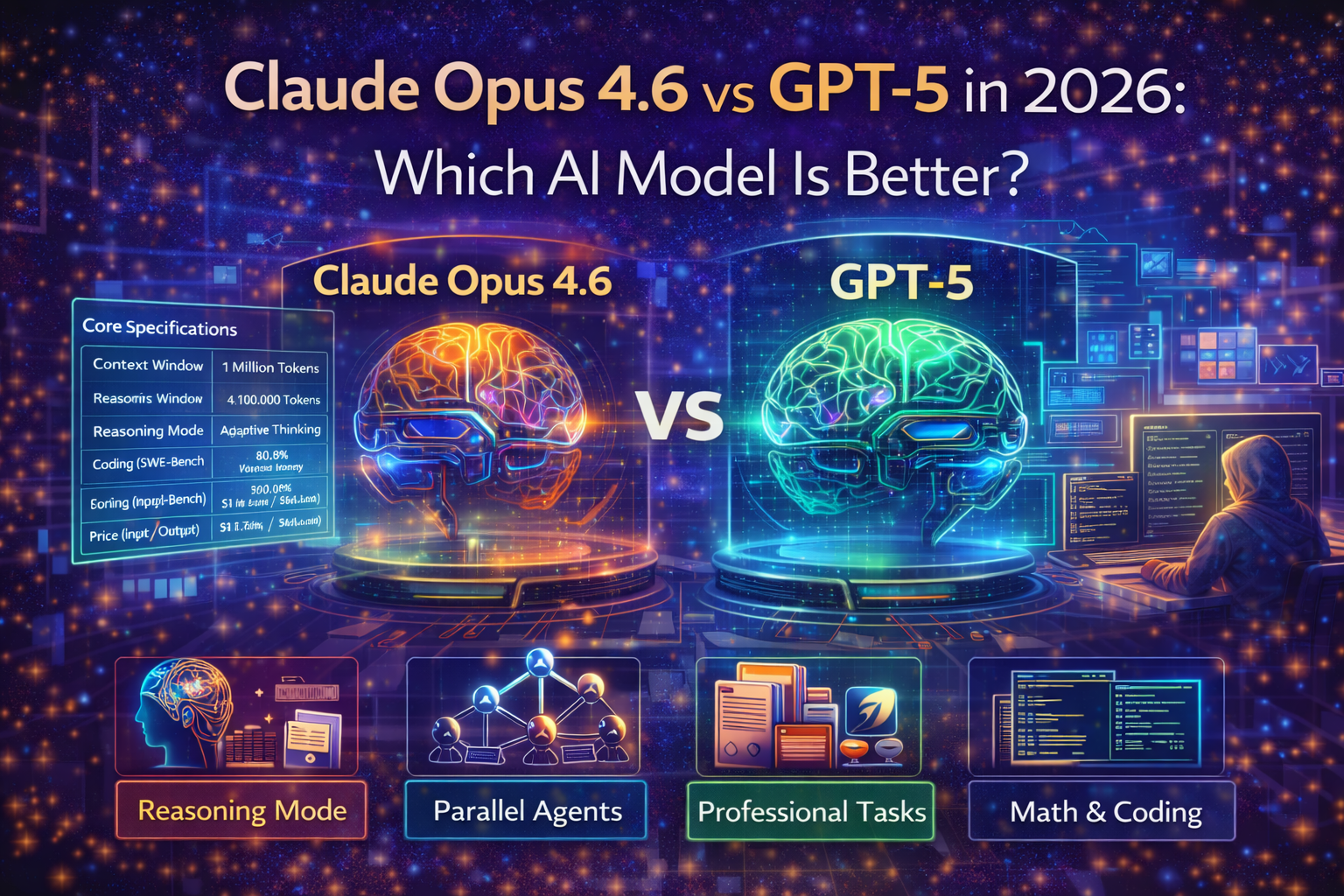
Claude Opus 4.6 vs GPT-5: 2026 Flagship Comparison
The defining difference lies in how each model thinks and operates at scale.
Claude Opus 4.6, released in February 2026 by Anthropic, introduced Adaptive Thinking. GPT-5.2 and GPT-5.3 Codex, developed by OpenAI, focus on Unified Reasoning and system-level execution.
Core technical differences include:
- Claude Opus 4.6: 1 million token context window with adaptive reasoning
- GPT-5.2 and GPT-5.3 Codex: 400,000 token context with strong math and coding depth
- Claude excels in agentic enterprise workflows
- GPT-5 leads in STEM, math, and terminal-level coding
Therefore, the choice depends more on workflow design than raw intelligence.
Reasoning Styles: Adaptive vs Unified Thinking
In 2026, models no longer just respond. They think.
Claude Opus 4.6 uses Adaptive Thinking. It evaluates prompt complexity and decides how much compute to spend. For example, it may analyze a legal contract for thirty seconds to catch edge cases. However, it responds instantly to simple queries. Consequently, efficiency and accuracy balance naturally.
GPT-5.2 uses Unified Reasoning with a default chain of thought. It excels in abstract reasoning and remains the undisputed leader in mathematics. It scored a perfect 100 percent on the AIME 2025 exams. Therefore, it performs best in physics, advanced calculus, and objective logic tasks.
The Rise of Agentic Workflows
The biggest differentiator in 2026 is how models interact with systems.
Claude Opus 4.6 is designed for agentic teams. It can spin up sub-agents that work in parallel. One agent can read documentation, another can write code, and a third can run tests. All of this happens inside its massive context window. Consequently, it excels at long running enterprise projects.
GPT-5.3 Codex focuses on terminal and CLI mastery. It leads Terminal-Bench 2.0 with a 77.3 percent score. Therefore, it is ideal for cloud deployments, CI/CD pipelines, and deep system debugging.
Professional Writing and Enterprise Safety
Claude Opus 4.6 remains the gold standard for professional neutrality. It reached a 1,606 Elo score on GDPval-AA for real-world work tasks. This is 144 points higher than GPT-5.2 in legal and financial accuracy. Additionally, it avoids exaggerated or moralizing language while staying grounded in provided data.
GPT-5.2 offers personality modes. After the retirement of GPT-4o, OpenAI introduced Warmth and Professional toggles. Consequently, GPT-5 regained creative flexibility while still supporting structured output.
Ecosystem and Cost Considerations
Cost matters at scale. GPT-5.2 is significantly more cost-effective for high volume API usage. Its input pricing is roughly one third of Claude Opus 4.6. Therefore, it suits startups and experimentation.
Claude Opus 4.6 introduces Context Compaction, a major 2026 breakthrough. It automatically summarizes older conversation segments. Consequently, teams can run week-long projects without hitting context limits.
Key cost and ecosystem points include:
- GPT-5 for cost efficiency and ecosystem breadth
- Claude for context longevity and enterprise stability
- Both support scalable professional deployment
Best Practices for Choosing the Right Model
Choosing wisely requires matching model strengths to task demands.
Use Claude Opus 4.6 when accuracy, long context, and parallel reasoning matter most. Additionally, use it for legal, financial, and policy heavy work.
Use GPT-5.2 or GPT-5.3 Codex when math, science, or terminal control dominates. Moreover, creative teams benefit from its tonal flexibility.
Avoid vague prompts with either model. Additionally, validate outputs before production use.
There is no universal winner in 2026. The decision is strategic, not emotional.
In the Claude Opus 4.6 vs GPT-5 comparison, Claude dominates agentic workflows, long context analysis, and enterprise safety. GPT-5.2 and GPT-5.3 Codex lead in mathematics, science, system-level coding, and cost efficiency. Consequently, many organizations use both models together for maximum leverage.
Choosing the right model means understanding your workload, risk tolerance, and scale.
Frequently Asked Questions(FAQ)
Which model is better for very large documents?
Claude Opus 4.6 performs better due to its 1 million token context and context compaction.
Is GPT-5 better for developers?
GPT-5.3 Codex is superior for terminal work, cloud automation, and system debugging.
Can enterprises safely combine both models?
Yes. Many teams use Claude for analysis and GPT-5 for execution, achieving optimal results.
Other Articles

How Can You Publish Your First Book in 2026 Step by Step?
How Is Ramadan 2026 Observed Around the World? Traditions Explained