
India is known as the land of festivals, and every celebration has a deep mythological, spiritual, or historical meaning behind it. Festivals are not just about rituals, food, or decorations — they are rooted in ancient stories that teach us values like truth, courage, love, devotion, and unity.
In this blog, let’s explore the mythology and stories behind some of India’s most important festivals.
1) Diwali — The Victory of Light over Darkness
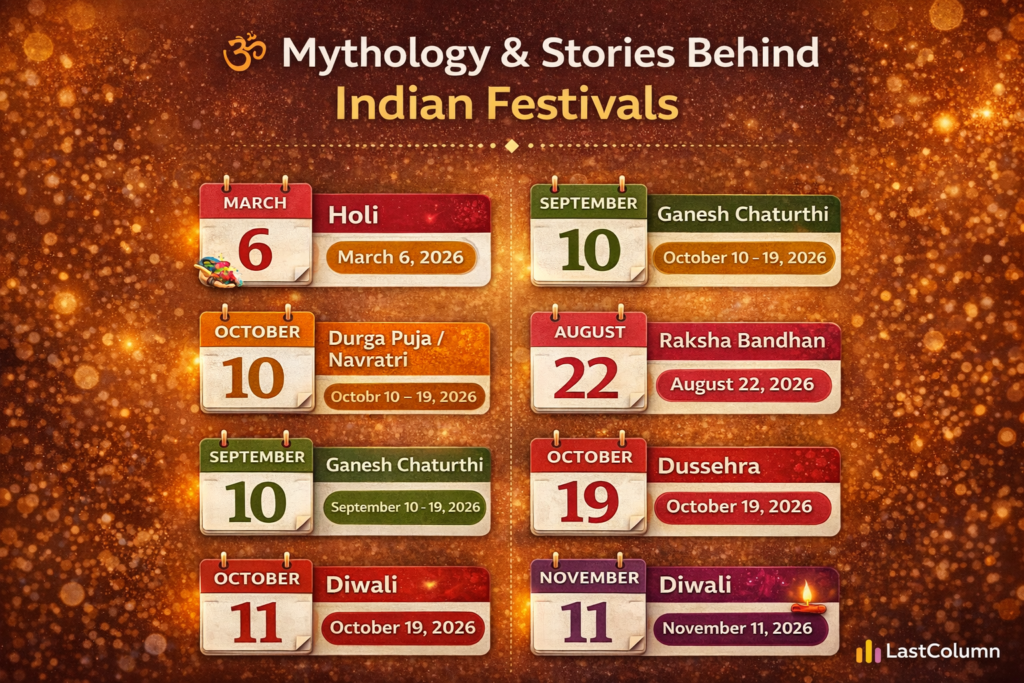
Celebration Date (2026): November 11, 2026 (date varies every year based on the Hindu lunar calendar)
Mythological Story:
Diwali celebrates the return of Lord Rama to Ayodhya after 14 years of exile and defeating the demon king Ravana. The people of Ayodhya lit oil lamps (diyas) to welcome him, symbolizing the victory of good over evil.
Meaning Today:
- Remove negativity
- Start new beginnings
- Spread happiness and hope
2) Holi — The Triumph of Devotion
Celebration Date (2026): March 6, 2026 (Holika Dahan on March 5, 2026)
Mythological Story:
Holi is linked to the story of Prahlad and Hiranyakashipu. Prahlad was a devotee of Lord Vishnu, and his aunt Holika tried to kill him using a magical fire. However, Holika burned while Prahlad survived due to divine protection.
Lesson:
Devotion and truth always win.
3) Durga Puja / Navratri — Goddess Power over Evil
Celebration Dates (2026):
- Navratri: October 10 – October 18, 2026
- Vijaya Dashami (Dussehra): October 19, 2026
Mythological Story:
This festival celebrates Goddess Durga defeating the demon Mahishasura, who could not be killed by any man. The gods combined their powers to create Durga, who fought for nine days and defeated him.
Significance:
- Feminine power
- Justice over cruelty
- Spiritual strength
4) Ganesh Chaturthi — Birth of Lord Ganesha
Celebration Date (2026): September 10, 2026
Mythological Story:
Goddess Parvati created Ganesha from clay to guard her privacy. When Lord Shiva returned and found Ganesha blocking his way, he unknowingly beheaded him. Later, he restored Ganesha’s life by giving him an elephant’s head.
Why we celebrate:
Ganesha is worshipped as the remover of obstacles and god of wisdom.
5) Raksha Bandhan — Bond of Protection
Celebration Date (2026): August 22, 2026
Mythological Background:
According to legend, Queen Draupadi tied a piece of cloth to Lord Krishna’s wrist to stop his bleeding, and in return, Krishna promised to protect her forever.
This symbolizes the sacred bond between brother and sister.
6) Karva Chauth — Love and Loyalty
Celebration Date (2026): October 31, 2026
This festival is associated with the story of Queen Veeravati, whose devotion and fasting brought her husband back to life. It highlights faith, love, and marital commitment.
7) Dussehra — Lord Rama vs Ravana
Celebration Date (2026): October 19, 2026
Dussehra marks the defeat of Ravana by Lord Rama, symbolizing the end of evil. Effigies of Ravana are burned across India as a reminder that arrogance and injustice will always fall.
Other Articles

AI & Emerging Tech in 2026: Trends, Impact & What’s Next
Upcoming Movies & TV Shows in 2026 — What to Watch This Year