
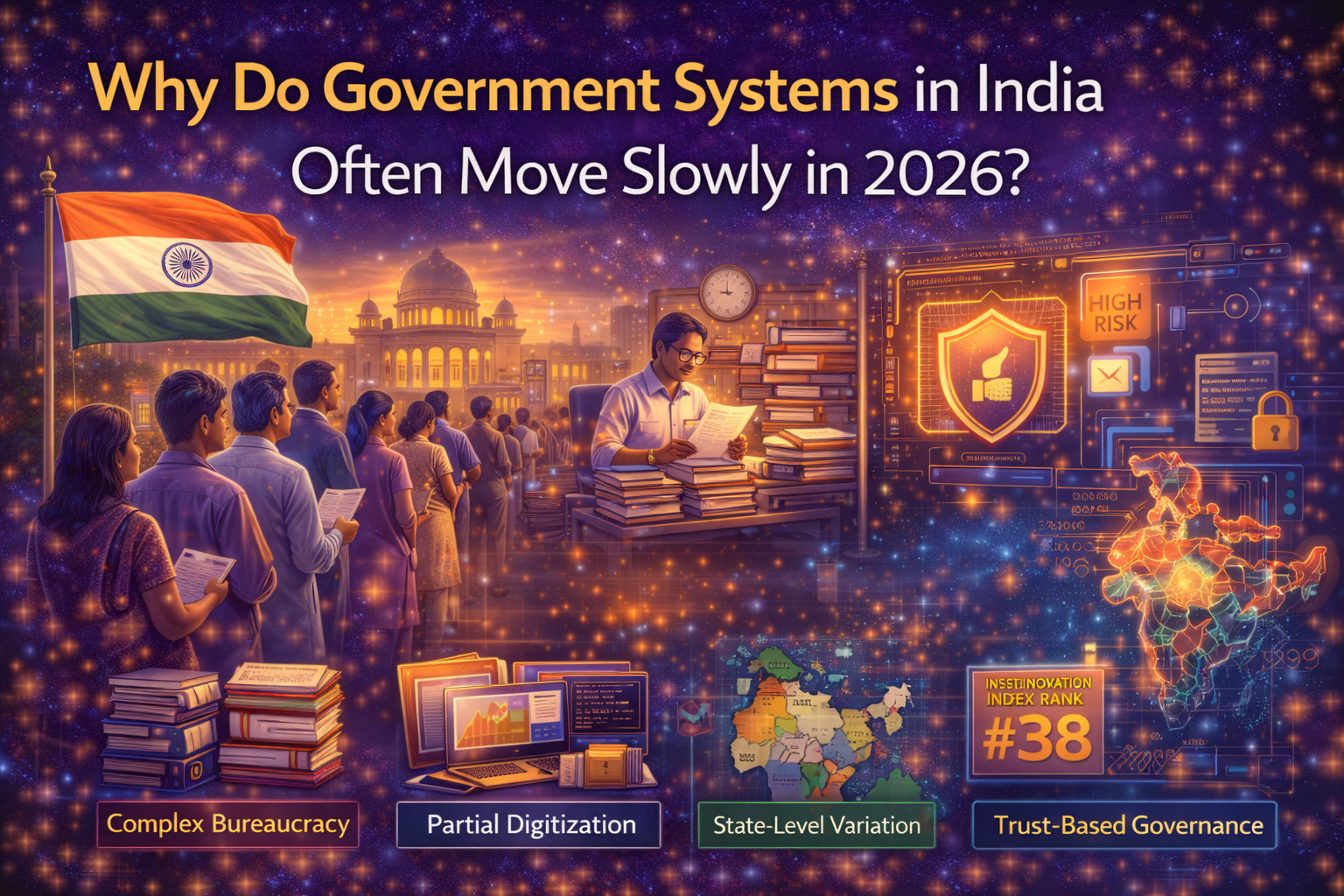
Many citizens feel frustrated when public services take time. Files move slowly, approvals delay, and processes feel complex. However, this situation has deeper structural reasons. Consequently, slow movement is rarely due to individual inefficiency.
This article explains Why Government Systems in India Often Move Slowly with clarity and balance. It explores historical causes, administrative challenges, and practical reforms shaping governance in 2026. Additionally, it highlights why progress often feels slow despite measurable improvement.
Historical and Structural Foundations
India’s administrative framework developed during colonial rule. It emphasized documentation, hierarchy, and control. Consequently, layered approvals became the norm.
After independence, the system expanded to serve a massive population. However, many legacy procedures remained unchanged. Therefore, paperwork increased rather than reduced.
India’s federal structure also affects speed. Powers distribute across central, state, and local governments. Consequently, coordination and consensus often take time.
Why Government Systems in India Often Move Slowly: Core Causes
Slowness in governance results from systemic design, not individual intent. Several factors combine to slow execution.
The most common causes include:
- Multi-layer approvals created to prevent misuse
- Heavy dependence on documentation and verification
- Strong audit and vigilance oversight
Each safeguard protects public interest. However, every added layer increases processing time. Consequently, caution often outweighs speed.
Bureaucracy and Administrative Complexity
Bureaucracy ensures fairness and consistency. However, excessive hierarchy creates bottlenecks. Consequently, simple approvals may take weeks.
Officers follow strict procedures because deviation invites scrutiny. Additionally, audit reviews often occur years later. Therefore, officials prefer caution over speed.
Frequent transfers also slow progress. New officers review files again to ensure compliance. As a result, continuity breaks and timelines extend.
Technology Gaps and Partial Digitization
India has invested heavily in digital governance. However, implementation remains uneven across departments and states. Some services operate fully online, while others rely on paper.
This hybrid system creates friction. A file may move digitally in one office and physically in another. Consequently, tracking becomes inefficient.
Key technology challenges include:
- Poor integration between departmental systems
- Limited staff training on digital tools
- Dependence on legacy software
Digitization improves speed only when processes change alongside technology.
The Shift Toward Trust-Based Governance
A major reform trend in 2026 is trust-based governance. Instead of checking every file equally, systems now assess risk levels. Consequently, low-risk citizens and businesses face fewer verifications.
Audits now focus on high-risk cases. This approach reduces workload and improves speed. Additionally, it encourages compliance instead of defensive paperwork.
While adoption varies, trust-based governance marks a clear move from blanket suspicion to intelligent oversight.
State-Level Variation in Speed
Government speed in India is not uniform. While central ministries digitize rapidly, state-level performance differs widely. Consequently, service quality depends heavily on location.
Some states deliver approvals quickly through integrated portals. Others still rely on manual workflows. Therefore, the same service may take days in one state and weeks in another.
This variation stems from leadership priorities, funding, and administrative capacity.
Productivity Gains Despite Perceived Slowness
Despite criticism, governance productivity continues to improve. In early 2026, India reached 38th place in the Global Innovation Index, a significant rise.
This ranking reflects stronger policy coordination and innovation output. Consequently, while processes may feel slow, outcomes show measurable progress.
Caution has not stalled growth. Instead, structured governance supports stability and long-term innovation.
Government systems move slowly due to structure, scale, and accountability. However, change is underway.
Understanding Why Government Systems in India Often Move Slowly reveals a system becoming smarter, not stagnant. Trust-based governance, state-level competition, and global innovation gains show progress. Consequently, in 2026, governance in India evolves toward predictability, transparency, and long-term efficiency.
Frequently Asked Questions(FAQs)
1. Are government systems slow only in India?
No. Large democracies worldwide face similar challenges due to scale and accountability.
2. Does digitization automatically improve speed?
No. Technology helps only when processes and training improve alongside it.
3. Will services become faster in the future?
Yes. Trust-based systems and state-level reforms continue improving delivery speed.
Other Articles

What Renewable Energy Breakthroughs in 2026 Are Powering the Future?
How Can You Publish Your First Book in 2026 Step by Step?