
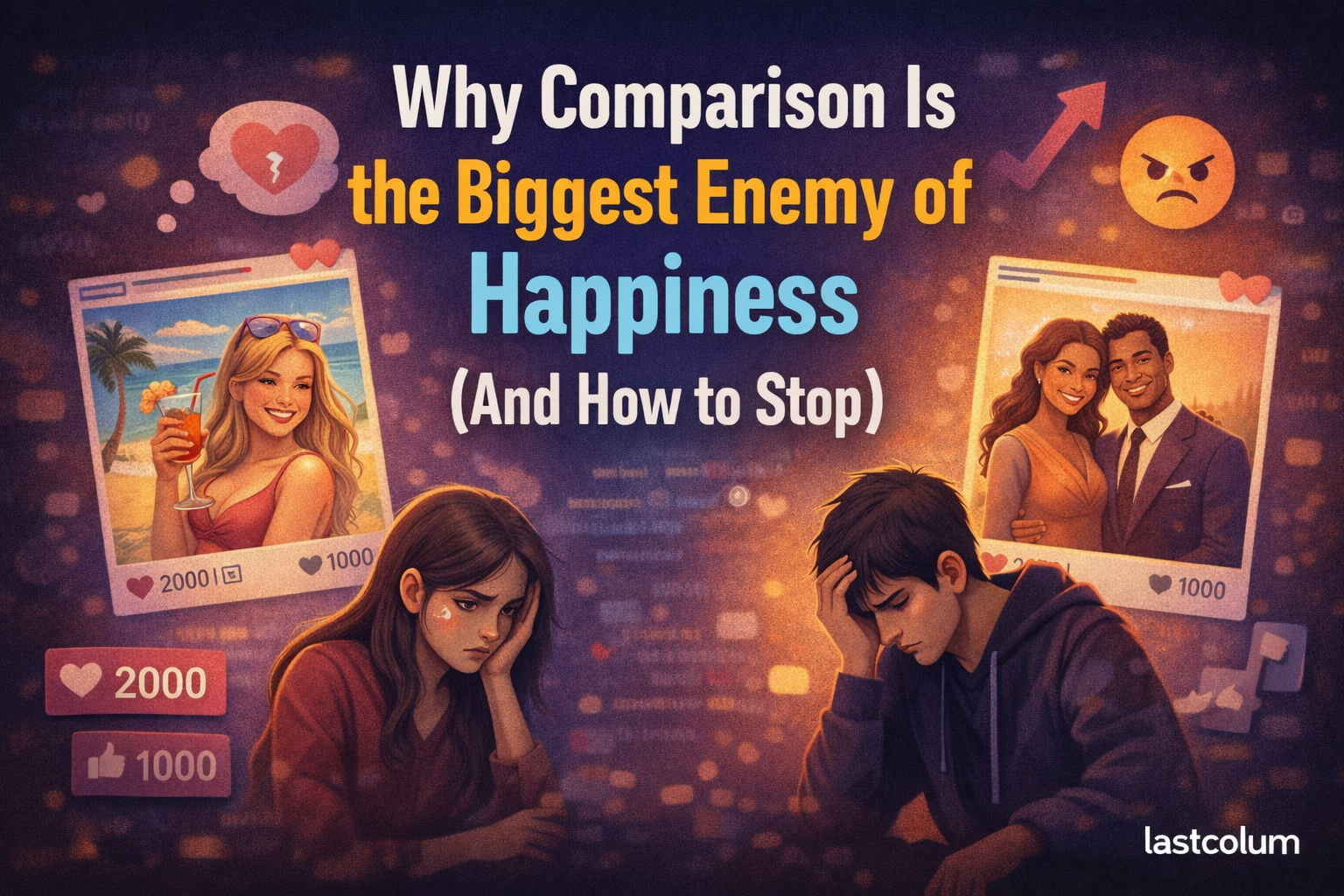
You open Instagram. Within 30 seconds, someone your age owns a flat, got promoted, or is on a beach in Thailand. You were fine a minute ago. Now you are not.
That shift is not weakness. It is comparison doing what it always does. Comparison is the enemy of happiness, and it works fast. Most people know this already. They just do not know how to stop.
Here is the actual reason it keeps happening, and what works to counter it.
Why Your Brain Compares in the First Place
Comparison is not a personality flaw. It is a survival mechanism. Early humans needed to read their social position fast. Am I safe here? Do I have enough? Am I falling behind the group?
That instinct still runs, but now it runs on social media, office culture, and family conversations. The inputs changed. The brain did not.
The result is that your mind scans for gaps constantly. Who earns more. Who looks more put together. This happens automatically. However, you can choose what you do after it triggers.
Why Social Media Makes It Worse
Comparison existed long before smartphones. But social media changed the scale entirely.
Before, you compared yourself to maybe 50 to 100 people you actually knew. Now you compare yourself to thousands of curated highlight reels every day. Furthermore, the algorithm pushes the most aspirational content first because it keeps you engaged longer.
You are not comparing your real life to someone else’s real life. You are comparing your Tuesday morning to their best Saturday, filtered and framed. That is not a fair comparison. It was never meant to be.
A 2018 University of Pennsylvania study found that participants who limited social media to 30 minutes per day reported significantly lower loneliness and depression after three weeks. The content did not change. The exposure did.
What Comparison Actually Costs You
Most people think of comparison as just a mood dip. It is more than that.
Comparison pulls your focus off your own path. When you measure your progress against someone else’s, you adopt their timeline and their definition of success. Your own progress feels worthless, even when it is not.
Moreover, it stops you from acting. People delay starting businesses, fitness goals, and creative work because someone else is already further ahead. Waiting to be good enough before you begin means waiting forever.
There is also the gratitude erosion. What you already have stops feeling like enough. A decent salary feels small next to a friend’s raise. Comparison turns genuine good things into evidence of falling short.
What Actually Helps
Awareness is the entry point, but it is not enough on its own. Here is what moves the needle.
Compete with your past self, not other people. The only comparison worth making is whether you are better than you were last month. That is a race you can win on your own terms.
Set your own measures of success early. If you do not decide what success looks like for you, someone else’s definition fills that gap. Write it down.
Reduce the inputs deliberately. You do not need to quit social media. However, curating your feed and muting accounts that consistently trigger comparison is practical, not an overreaction.
Name it when it happens. Psychologists call this labeling. When you notice comparison starting, say it in your head: “I am comparing right now.” That puts distance between the feeling and your response.
Practice noticing what you already have. Just a brief, regular habit of acknowledging what is already working. It does not come naturally at first. That is exactly the point.
Frequently Asked Questions(FAQs)
1. Why is comparison the enemy of happiness?
Comparison shifts your focus from your own progress to someone else’s. It makes you measure yourself against timelines you never chose. Over time, it erodes gratitude and stops you from appreciating what you already have.
2. How do I stop comparing myself to others on social media?
Reduce exposure first. Limit daily screen time and mute accounts that consistently trigger comparison. Remind yourself that social media shows curated highlights, not real life. Then build a habit of checking your own goals instead of scrolling.
3. Is comparing yourself to others ever useful?
Occasionally. Comparing yourself to someone slightly ahead can clarify what is possible and motivate action. The problem starts when comparison becomes constant, targets people far outside your context, or ties to your sense of self-worth rather than simple goal-setting.
Other Articles

How to Switch Careers in Your 30s Without Starting Over?
How Do JavaScript Closures, Promises & Async/Await Work?