
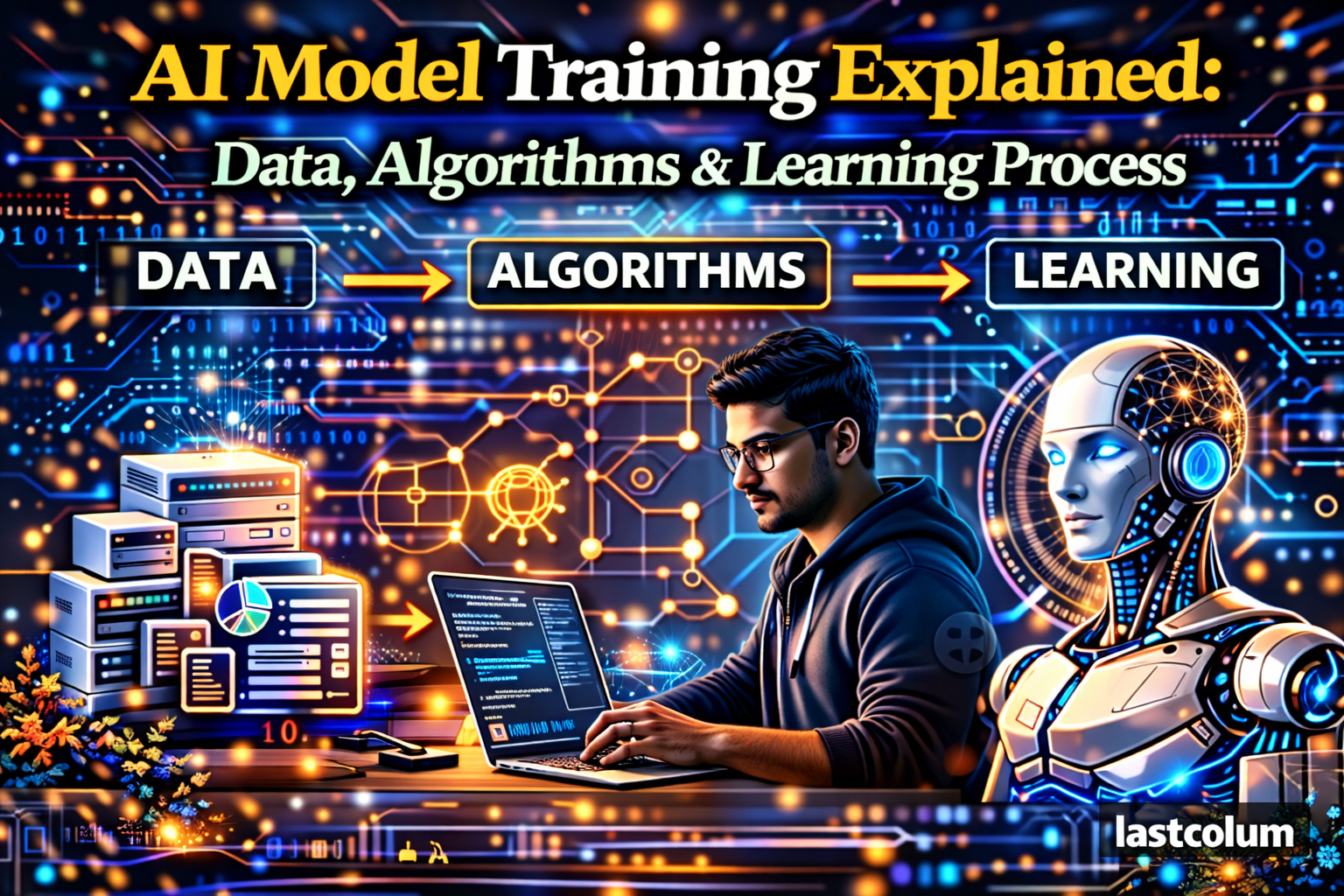
When people talk about AI being trained, they usually mean something more specific than the word suggests. A model does not learn the way a student does. It adjusts numbers until the numbers produce outputs that match what it has been shown.
Understanding how AI model training works explains why bad data produces bad models, why training takes so much computing power, and why improving a model often means feeding it more examples.
What Is a Model, Actually?
An AI model is a mathematical function. It takes inputs and produces outputs. The inputs might be text, images, audio, or numbers. The outputs might be predictions, classifications, or generated content.
The model itself is a large set of numbers called parameters or weights. At the start of training, these weights are typically random. Training is the process of adjusting those weights until the output consistently matches what you want.
A large language model has billions of parameters. Each one influences how the model processes language. Training adjusts all of these numbers, slightly, many times, until the model’s outputs become useful.
How Data Works in Training
Data is not just fuel. Data is the definition of what the model should learn.
If you want a model that detects spam emails, you train it on labeled examples of spam and non-spam. The model learns which patterns in the input text correspond to spam. It does not understand spam conceptually. It learns that certain combinations of words tend to appear in messages labeled as spam.
Furthermore, the quality and representativeness of data determines the quality of the model. A spam detector trained only on English emails performs poorly on other languages. A medical image classifier trained on one hospital’s scans may fail on another’s. The model learns what it is shown. Nothing more.
Moreover, volume matters in counterintuitive ways. More examples give the model a better statistical picture of the patterns it needs to learn. This is why companies with large datasets have a significant advantage in building capable models.
What Algorithms Do
The algorithm tells the model how to adjust its weights during training.
The most common approach is gradient descent. You feed the model an example, it produces an output, and you compare that output to the correct answer. The difference is the loss. The algorithm calculates how each weight contributed to that loss and adjusts each weight slightly to reduce it. This happens billions of times across the entire training dataset.
Backpropagation calculates how much each weight contributed to the error by running the calculation backward through the model. Consequently, weights that contributed more to the wrong answer get adjusted more.
The learning rate controls how much each weight changes per update. Too high and the model becomes unstable. Too low and training takes too long.
Why Training Takes So Much Compute
Training requires performing billions of weight updates across trillions of data examples. Each calculation is simple. The volume is enormous. Additionally, the computations run across massive parallel hardware, typically arrays of GPUs or specialized chips like TPUs.
Training a large model reportedly costs tens of millions of dollars in compute. Smaller models for narrower tasks cost far less, but the principle is the same. More parameters, more data, and more training steps all require more compute.
This is why training and inference are very different workloads. Inference, using a trained model to answer a question, is relatively cheap. Training is expensive, which is why most organizations use models trained by others rather than training from scratch.
Frequently Asked Questions(FAQs)
1. What is the difference between training and inference in AI?
Training is the process of adjusting a model’s weights by exposing it to data and correcting errors over many iterations. Inference is using a trained model to produce outputs for new inputs. Training is computationally expensive and happens once or periodically. Inference is relatively cheap and happens every time someone uses the model.
2. How much data does an AI model need to train properly?
It depends on the task and model architecture. Simple classifiers can train on thousands of examples. Large language models train on hundreds of billions or trillions of tokens. More diverse, high-quality data produces better models. The minimum is the amount required to represent all the patterns the model must learn.
3. Can an AI model learn from incorrect or biased data?
Yes. Models learn patterns from whatever data they are given. If that data contains errors, the model replicates those errors. If the data reflects historical biases, the model learns those biases. Garbage data reliably produces garbage models, which is why data curation and quality control are as important as algorithm design.
Other Articles
How Can You Become an AI ML Engineer Without a Degree?