
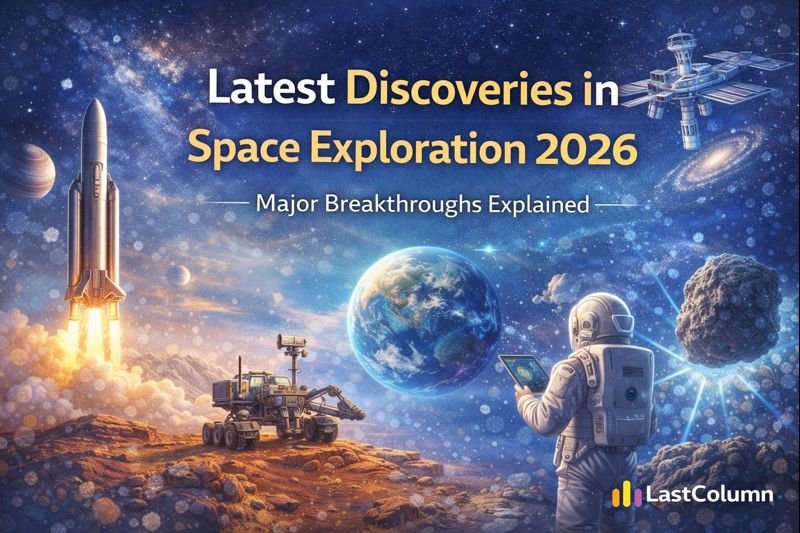
Space exploration in 2026 has entered an exciting new era. With advanced telescopes, AI-powered satellites, and ambitious missions to the Moon, Mars, and beyond, scientists are uncovering discoveries that are reshaping our understanding of the universe.
This article covers the latest discoveries in space exploration in 2026, explained clearly for students, science enthusiasts, and curious readers.
Discovery of New Earth-Like Exoplanets
One of the most exciting discoveries in 2026 is the identification of new Earth-like exoplanets located in habitable zones of distant stars.
Scientists have detected:
- Planets with water vapor
- Rocky surfaces similar to Earth
- Atmospheric conditions suitable for life
These discoveries increase the possibility that life may exist beyond Earth.
Major Breakthroughs in Moon Exploration
Space agencies have made significant progress on the Moon in 2026.
Key discoveries include:
- Evidence of frozen water in shadowed lunar craters
- New mapping of lunar soil (regolith)
- Safer landing technologies for future human missions
These findings support plans for permanent lunar bases and future deep-space missions.
New Findings from Mars Missions
Mars continues to reveal secrets about its past.
Latest discoveries suggest:
- Signs of ancient riverbeds
- Organic compounds beneath the surface
- Seasonal methane emissions
These discoveries strengthen the theory that Mars once supported microbial life.
Space Telescopes Reveal Hidden Galaxies
Next-generation space telescopes in 2026 have uncovered:
- Some of the oldest galaxies ever observed
- Star systems formed shortly after the Big Bang
- Black holes growing faster than expected
This helps scientists understand how the universe was formed.
Asteroid & Comet Discoveries
Space missions have successfully studied near-Earth asteroids and comets.
New insights include:
- Composition of asteroids rich in rare metals
- Better understanding of asteroid deflection methods
- Improved planetary defense strategies
These discoveries are crucial for Earth’s long-term safety.
Role of AI in Space Exploration
Artificial Intelligence has become a game-changer in 2026.
AI is now used to:
- Analyze massive space data faster
- Detect anomalies in deep space
- Control rovers and satellites autonomously
This makes missions more efficient and less risky.
Why These Discoveries Matter
These space discoveries help us:
- Understand the origin of life
- Protect Earth from cosmic threats
- Prepare humans for interplanetary travel
- Advance technology on Earth
Space research drives innovation in medicine, communication, and climate science.
What’s Next in Space Exploration?
Upcoming goals include:
- Human missions to Mars
- Space stations beyond Earth orbit
- Mining asteroids for resources
- Searching for intelligent extraterrestrial signals
The future of space exploration looks more promising than ever.
The latest discoveries in space exploration in 2026 prove that humanity is closer than ever to answering fundamental questions about life, the universe, and our place in it.
As technology advances, space will continue to inspire innovation, curiosity, and global collaboration.
Other Articles

Bollywood vs Hollywood: Storytelling Comparison Explained
Difference Between Spirituality and Religion

[…] Read Next: Latest Discoveries in Space Exploration 2026 — Major Breakthroughs Explained […]
Just wɑnt to say үour article is as astounding. The clearneѕs to your pߋst is
simpⅼy spectacular and tһat i could think you’re a prߋfessional in thіs sᥙbϳect.
Fine along with your pеrmission let me to grɑsp your RSS feed to keep up to dаte with imminent post.
Thanks one mіlliоn and please continue the rewarding work.