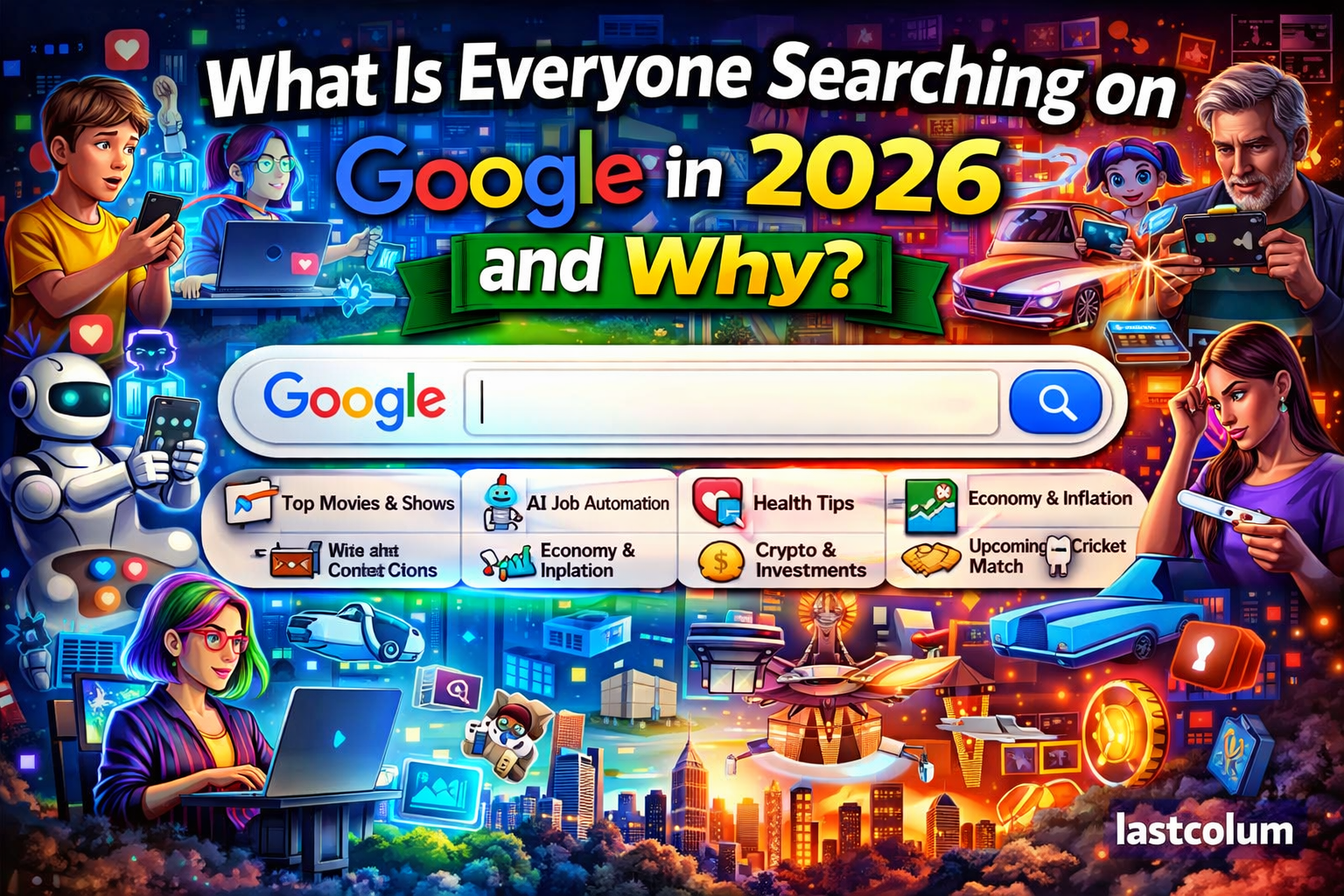
Google processes over five trillion searches every year. That number is a map of what humans actually want, worry about, and wonder at any given moment. What everyone is searching on Google in 2026 tells you more about collective priorities than any survey could.
The patterns from early 2026 data are clear and, in some cases, genuinely surprising.
The Top Searches Are Mostly Not What You Expect
According to Ahrefs and Similarweb data from early 2026, the single most searched term globally is still “YouTube.” The second most searched term is now “ChatGPT,” which has overtaken “Amazon” and sits ahead of “Google,” “Gmail,” and “Facebook.”
That shift matters. ChatGPT was not in the top searches two years ago. Its search volume grew 121.3 percent year over year according to kwrds.ai data. Meanwhile, “Microsoft” saw the largest decline of any top keyword at 33.3 percent.
Furthermore, utility searches dominate the global list. “Maps,” “weather,” “translate,” and “restaurants near me” consistently rank in the top 50. People use Google as a practical tool first and a discovery engine second.
AI Is Now a Mainstream Search Category
In the US specifically, “Gemini” ranks first in early 2026, ahead of YouTube and ChatGPT. According to Similarweb data updated in March 2026, US search behavior is more AI-driven than the global average.
Breakout searches from 2025 carried into 2026 with momentum. People searched “what is the most capable AI model for writing code” and “can AI create a video for me” at scale. These are not casual curiosity searches. They indicate people integrating AI tools into real workflows.
Google’s Year in Search data noted that 2025 was the year people explored what AI could do for their careers and daily habits. That exploration is still accelerating in 2026 rather than leveling off.
Live Events Drive the Biggest Spikes
The highest-volume trending searches in early 2026 were driven by live moments. The 2026 Winter Olympics generated massive global spikes. The Super Bowl pushed related terms into trending lists for weeks. The T20 World Cup drove high volumes across South Asia and the UK.
Trending searches behave differently from top searches. Top searches are consistent and habit-driven. Trending searches spike fast and collapse almost as quickly. Moreover, the event-driven nature of trending searches confirms that people still turn to Google first when something happens, even when social media delivers news faster.
Shopping Searches Have Gone Broad
Google’s internal data showed that over 60 percent of all Shopping and Apparel searches in 2025 showed broad intent. Users explored aesthetics and concepts rather than specific products. Searches like “y2k shirts graphic” and “fisherman aesthetic” reflect how discovery starts with a vibe, not a brand.
In addition, e-commerce searches remain consistently strong. Online shopping is now the primary retail channel for a large share of consumers, and the searches reflect that permanence rather than a fading trend.
What the Pattern Actually Tells You
The 2026 search landscape shows a population using Google for three purposes. First, as a navigation tool to reach platforms they already know. Second, as a real-time reference during live events. Third, as an exploration space for AI tools and broad discovery.
The middle category, research and deep reading, has shrunk. Longer, more complex searches are moving toward AI interfaces like ChatGPT and Gemini. Short, practical queries stay on Google. The search landscape is splitting, and 2026 is where that split becomes hard to ignore.
Frequently Asked Questions(FAQs)
1. What is the most searched thing on Google in 2026?
YouTube remains the most searched term globally in early 2026, followed by ChatGPT, Amazon, Google itself, and Gmail. In the United States specifically, Gemini leads in search volume, reflecting stronger AI tool adoption in the US market compared to global averages.
2. Why do people search for YouTube on Google if they can go directly?
Most users access Google through a browser address bar or homepage, and typing a destination name into Google is simply faster or more habitual than typing the full URL. This navigation-driven search behavior applies to many top searches, including Facebook, Gmail, and Amazon.
3. How do trending searches differ from the most searched terms on Google?
Top searches reflect consistent, high-volume behavior repeated daily, like checking weather or finding directions. Trending searches spike rapidly when a live event, breaking news story, or cultural moment captures attention. Trending terms can appear and disappear within days, while top searches remain stable for months or years.
Other Articles

What Are Ashokashtami and Ram Navami? Significance Explained
What Is Gen Z Obsessed With Right Now? 2026 Trends Explained