
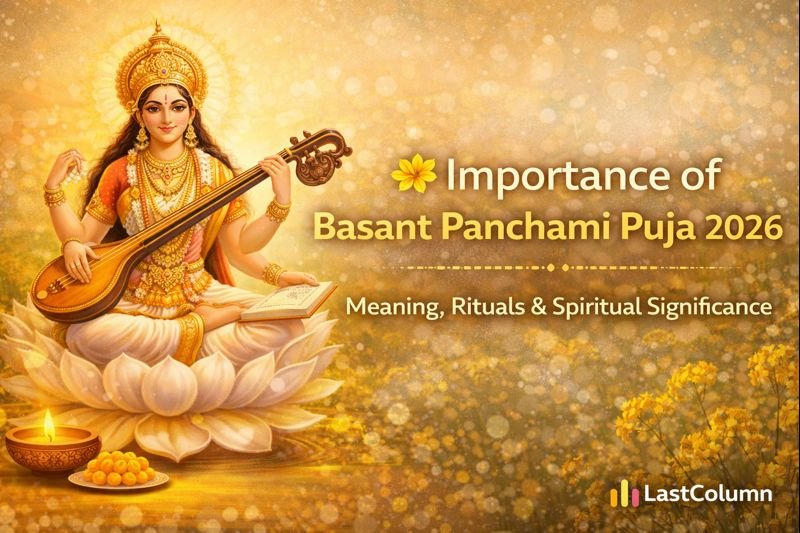
Basant Panchami is one of the most sacred and joyful festivals in India. It marks the arrival of spring (Basant Ritu) and is dedicated to Goddess Saraswati, the goddess of knowledge, wisdom, music, art, and learning.
As per the Panchang, the Panchami Tithi of Shukla Paksha in the month of Magh will begin on 23 January 2026 at 02:28 am and conclude on 24 January 2026 at 01:46 am.
This day holds deep cultural, spiritual, and educational importance in Indian tradition.
Why is Basant Panchami Celebrated?
Basant Panchami symbolizes:
- New beginnings
- Growth and creativity
- Wisdom and learning
- End of winter and start of spring
- Prosperity and positivity
Farmers, students, artists, and spiritual seekers especially celebrate this day with devotion and gratitude.
Mythological Story Behind Basant Panchami
According to Hindu mythology, when Lord Brahma created the universe, the world was silent and lifeless. There was no sound, no rhythm, and no expression. To bring harmony and intelligence into creation, Lord Brahma manifested Goddess Saraswati from his mind.
She appeared dressed in white, holding a veena, a book, and prayer beads, symbolizing knowledge, creativity, and discipline. As she played the veena, sound and wisdom filled the universe.
Her blessings gave humans:
- Language
- Intelligence
- Music
- Art
- Scientific thinking
This divine appearance of Saraswati is believed to have happened on Basant Panchami, which is why the day is dedicated to her worship. That is why Basant Panchami is also called Saraswati Puja.
Importance for Students & Education
Basant Panchami is considered the most auspicious day for students because:
- Many children begin formal education on this day (Vidya Arambh).
- Schools and colleges organize Saraswati Puja.
- Students seek blessings for success in exams and careers.
It is believed that praying to Goddess Saraswati improves memory, concentration, and intelligence.
Importance for Farmers
For farmers, Basant Panchami is very significant because:
- It marks the blooming of mustard flowers in yellow.
- It signals a healthy harvest season.
- Farmers thank nature for the abundance and fertility of the land.
The yellow color represents prosperity, optimism, and spiritual light.
How is Basant Panchami Puja Performed?
Common rituals include:
- Saraswati idol or picture is placed on a clean platform.
- Flowers, especially yellow ones, are offered.
- Books, musical instruments, and tools are kept near the deity.
- Mantras and bhajans are chanted.
- Prasad of yellow sweets like boondi or kesar halwa is distributed.
Many people wear yellow clothes as it symbolizes knowledge and positivity.
Spiritual Significance of Yellow Color
Yellow on Basant Panchami represents:
- Knowledge and enlightenment
- Growth and prosperity
- Energy and joy
- Spiritual awakening
It connects humans with divine wisdom.
Saraswati Puja in Schools & Colleges
Across India, especially in West Bengal, Odisha, Bihar, and Uttar Pradesh:
- Schools organize a grand Saraswati Puja.
- Cultural programs, music, and dance are performed.
- Students participate with devotion and excitement.
This strengthens respect for education and culture.
Why Basant Panchami Matters Today
In today’s digital and competitive world, Basant Panchami reminds us that:
- Knowledge is the greatest wealth.
- Creativity must be respected.
- Learning should be continuous.
- The balance between science and spirituality is important
Basant Panchami: More Than a Festival
Beyond the stories, Basant Panchami symbolizes the shift from darkness to light, ignorance to knowledge, and cold stillness to vibrant life. It reminds people that wisdom and creativity are divine gifts meant to be nurtured.
In essence, the mythological story behind Basant Panchami celebrates knowledge, renewal, and harmony, making it a meaningful festival for students, artists, and seekers of wisdom
Other Articles

Republic Day Sale 2026: The Biggest Shopping Event of the Year
Meditation & Mindfulness — A Practical Guide for a Calm Mind (2026)