
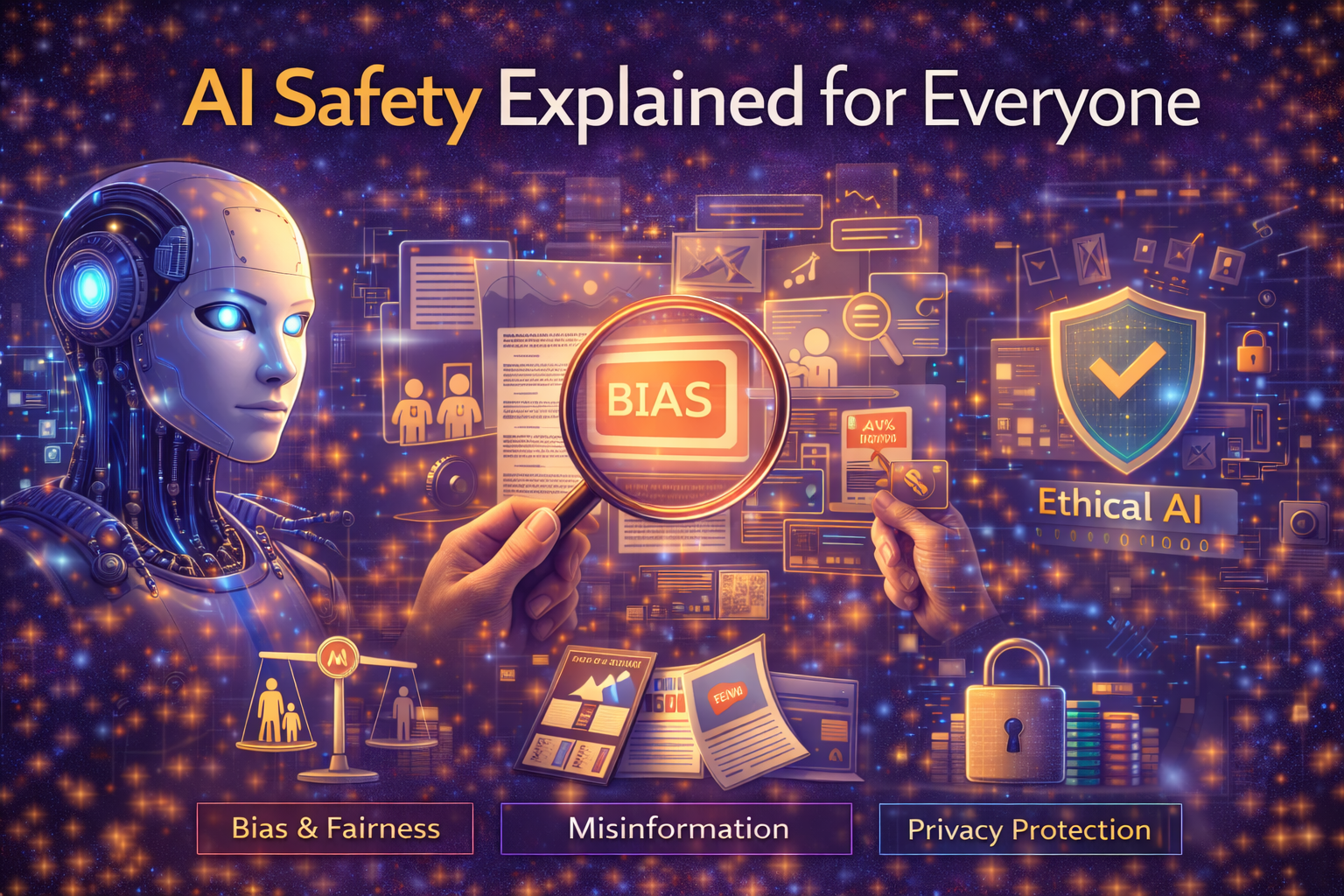
Artificial intelligence now shapes daily life. People use it for search, work, healthcare, finance, and entertainment. However, rapid adoption also raises serious questions. Consequently, safety becomes as important as innovation.
This guide on AI Safety Explained for Everyone breaks down complex ideas into clear language. It explains what AI safety means, why it matters, and how risks are managed in 2026. Additionally, it helps everyday users understand their role in safer AI use.
What Is AI Safety in Simple Terms?
AI safety focuses on ensuring that AI systems behave as intended. It aims to prevent harm, misuse, and unintended outcomes. However, safety does not mean stopping progress.
AI systems learn from data and instructions. Consequently, errors in data or design can lead to harmful results. Safety practices reduce these risks through testing, monitoring, and controls.
In simple terms, AI safety ensures systems help people instead of hurting them. It protects users, organizations, and society as a whole.
AI Safety Explained for Everyone: Core Risk Areas
Understanding risks helps explain why safety matters. Most concerns fall into a few clear categories.
The main AI risk areas include:
- Biased or unfair decisions caused by flawed data
- Misinformation or harmful content generated at scale
- Privacy and data misuse
Each risk affects real people. Therefore, safety measures focus on prevention, not reaction.
Bias and Fairness in AI Systems
AI systems reflect the data they learn from. If data contains bias, results may become unfair. Consequently, some groups may face discrimination.
This problem appears in hiring tools, lending systems, and facial recognition. However, bias is not intentional. It often comes from historical data patterns.
To reduce bias, developers audit datasets and test outputs across groups. Additionally, diverse teams review results. Therefore, fairness improves through deliberate design choices.
Misinformation and Harmful Content
Generative AI can produce text, images, and videos quickly. However, this power can spread false information. Consequently, misinformation risks increase.
Safety systems now filter harmful outputs and flag uncertainty. Additionally, AI tools label synthetic content clearly. Therefore, users can judge credibility better.
Platforms also limit sensitive topics. These controls reduce harm without blocking useful information entirely.
Privacy and Data Protection
AI systems often process large amounts of data. If mishandled, personal information can leak. Consequently, privacy becomes a core safety concern.
Modern AI safety practices focus on data minimization and encryption. Systems store less data and protect what they keep. Additionally, access controls limit misuse.
Users also gain more transparency. Clear consent and data use policies improve trust and accountability.
How AI Safety Is Built Into Systems
Safety does not happen automatically. It requires deliberate steps throughout development and deployment.
Key safety practices include:
- Rigorous testing before public release
- Continuous monitoring after deployment
- Human oversight for critical decisions
These steps reduce unexpected behavior. Consequently, AI systems remain reliable as they evolve.
Safety teams also simulate worst case scenarios. This preparation helps systems respond correctly under stress.
Regulation and Governance in 2026
Governments now play a larger role in AI safety. Regulations set standards for transparency, accountability, and risk management. Consequently, companies must comply or face penalties.
Rules focus on high risk use cases like healthcare, finance, and elections. Additionally, developers must document how systems work.
Regulation aims to protect users without blocking innovation. Balanced governance remains the goal.
The Role of Companies and Developers
Organizations building AI carry significant responsibility. They must design systems responsibly and respond to issues quickly.
Many companies now publish safety reports. Additionally, independent audits verify compliance. Therefore, trust improves through openness.
Developers also receive ethics and safety training. This awareness helps prevent harmful shortcuts during development.
What Everyday Users Can Do
AI safety is not only for experts. Users also play a role.
Simple actions include:
- Verifying important information from multiple sources
- Avoiding sharing unverified AI generated content
- Understanding basic AI limitations
Awareness reduces misuse and panic. Consequently, informed users strengthen overall safety.
Why AI Safety Supports Innovation
Some fear safety slows progress. However, unsafe systems lose trust quickly. Consequently, safety enables long term adoption.
Reliable AI encourages broader use in healthcare, education, and business. Additionally, trust attracts investment and talent.
Safety and innovation support each other when balanced correctly.
AI continues transforming how people live and work. However, power without safeguards creates risk.
Understanding AI Safety Explained for Everyone helps users, developers, and policymakers make better decisions. Additionally, it highlights shared responsibility across society. Consequently, AI can grow safely, ethically, and sustainably in 2026 and beyond.
Frequently Asked Questions(FAQs)
1. Is AI safety only a concern for experts?
No. Everyone using AI should understand basic risks and responsible use.
2. Does AI safety limit what AI can do?
No. It guides development to reduce harm while allowing innovation.
3. How can users protect themselves from AI risks?
Verify information, protect personal data, and understand that AI can make mistakes.
Other Articles

How Do Businesses Use AI to Increase Profits in 2026 Effectively?
What Renewable Energy Breakthroughs in 2026 Are Powering the Future?