
Most people rarely think about satellites. However, they rely on them every single day. From checking weather updates to using maps, satellite technology works silently in the background. Consequently, modern life would look very different without them.
Understanding How Satellites Help in Daily Life makes you appreciate how connected the world truly is. Additionally, satellites support communication, safety, business, and even farming. This guide explains their uses, benefits, and real world examples in simple terms.
How Satellites Help in Daily Life: Core Functions Explained
Satellites orbit Earth and collect or transmit information. They send signals to ground stations and devices worldwide. Therefore, they act like space based communication towers.
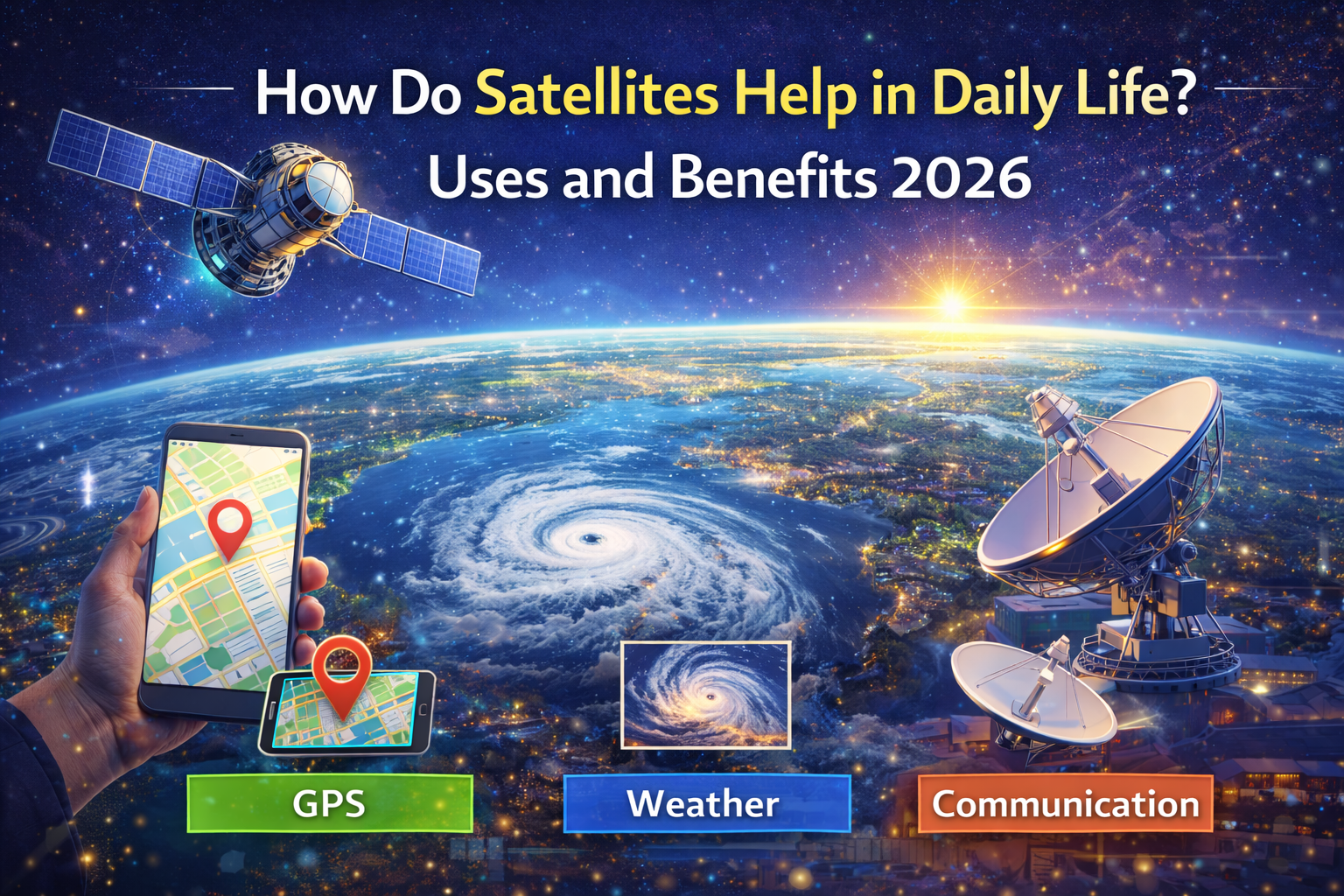
Their main roles include communication, navigation, and Earth observation. Consequently, they influence everything from phone calls to disaster alerts.
The three most important satellite functions are:
- Communication services like television and internet
- Navigation systems such as GPS
- Weather monitoring and disaster tracking
Each function plays a major role in daily convenience and safety.
Communication and Internet Services
Satellites allow global communication. However, this benefit often goes unnoticed. When you watch live sports or join a video call, satellite systems may carry the signal.
Remote areas especially depend on satellite internet. Additionally, ships and airplanes use satellite communication to stay connected. Consequently, travelers remain online even in the middle of oceans.
Satellite television also reaches rural regions. Therefore, information and entertainment spread widely. Without satellites, global broadcasting would become slower and limited.
Navigation and GPS Technology
Navigation is one of the most practical uses. GPS satellites send signals that help smartphones calculate location accurately. Consequently, apps provide directions within seconds.
Delivery companies rely heavily on GPS tracking. Additionally, ride sharing services depend on precise satellite data. Therefore, efficient transport systems exist because of space technology.
Emergency services also use satellite positioning. As a result, ambulances and rescue teams find locations faster during crises.
Even farmers use GPS enabled tractors. Consequently, they improve crop planting and reduce waste.
Weather Forecasting and Disaster Management
Weather satellites monitor clouds, storms, and temperature changes. However, their importance becomes clear during extreme events.
Meteorologists analyze satellite images to predict cyclones and heavy rainfall. Consequently, governments issue early warnings to save lives. Additionally, satellite data tracks wildfires and floods in real time.
Key disaster related benefits include:
- Early cyclone detection and evacuation planning
- Flood mapping for rescue operations
- Monitoring drought conditions for farmers
These systems reduce damage and improve emergency response. Therefore, satellites protect both property and human life.
Banking, Business, and Everyday Transactions
Satellites also support financial systems. Many ATM networks use satellite links for secure communication. Consequently, transactions process smoothly across regions.
Stock markets rely on precise timing signals from satellite systems. Additionally, logistics companies track shipments globally. Therefore, global trade depends heavily on space technology.
Telecommunication towers sync signals using satellite clocks. As a result, mobile networks operate accurately and efficiently.
Without these invisible systems, many daily services would slow down significantly.
Environmental Monitoring and Climate Research
Satellites help scientists study Earth from space. They measure pollution levels, ice melting, and forest cover. Consequently, researchers understand climate change better.
Governments use this data for environmental planning. Additionally, satellite images help track illegal deforestation and ocean pollution. Therefore, sustainability efforts become more effective.
Farmers also benefit from soil and crop analysis through satellite imagery. As a result, food production improves with better planning.
Benefits of Satellite Technology in 2026
Satellite systems continue improving each year. However, their core benefits remain clear.
Major advantages include:
- Global connectivity without physical cables
- Accurate real time data for navigation and weather
- Faster emergency response and public safety alerts
Additionally, new low orbit satellite networks promise faster internet speeds. Consequently, rural digital access will expand further in 2026.
Technology from space now supports nearly every industry. Therefore, satellites remain essential for progress.
Satellites may seem distant in space, but their impact stays close to home. From navigation to weather alerts, they quietly power modern life.
When you understand How Satellites Help in Daily Life, you realize how dependent we are on this invisible network. Additionally, future upgrades will expand connectivity and safety even more. Consequently, satellite technology will continue shaping daily routines in 2026 and beyond.
Frequently Asked Questions(FAQ)
1. How do satellites help in daily communication?
Satellites transmit television, phone, and internet signals across long distances.
2. Do GPS systems work without satellites?
No. GPS relies on signals from multiple satellites to calculate accurate location data.
3. How do satellites help during natural disasters?
They monitor storms, floods, and wildfires. Consequently, authorities can issue early warnings and plan rescues efficiently.
Other Articles

How to Follow Next.js App Best Practices 2026 for Speed and SEO?
What Are India’s New AI Content Rules Explained for Social Media 2026?