
Only one month left for exams and feeling stressed?
Don’t worry — 30 days is enough if you follow the right strategy.
Many students waste time studying randomly. But success comes from smart planning, focused study, and consistent revision.
This guide shows you exactly how to prepare for exams in one month with a practical daily plan that actually works.
First Rule: Don’t Panic, Plan
Panic wastes energy. Planning saves time.
Instead of saying:
❌ “Syllabus is too big”
Say:
✅ “I will finish 3 chapters daily”
Small daily wins build confidence.
Step 1: Divide Your 30 Days Smartly
Use this proven formula:
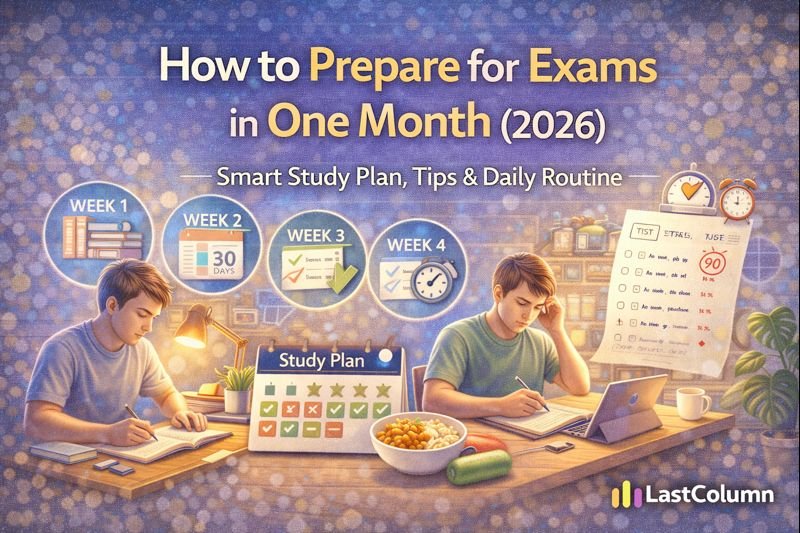
✅ Week 1 → Learn concepts
✅ Week 2 → Finish syllabus
✅ Week 3 → Revision
✅ Week 4 → Mock tests + weak areas
This method prevents last-minute stress.
30-Day Study Plan Breakdown
Days 1–7: Understand Concepts
Focus on:
- reading theory
- understanding basics
- clearing doubts
Don’t memorize yet — just understand.
Tip:
👉 Study hardest subjects first.
Days 8–15: Complete Syllabus
Now:
- finish remaining chapters
- make short notes
- highlight important formulas
Goal: 100% syllabus completion
No procrastination here.
Days 16–23: Revision Time
This is where toppers win.
Do:
- revise daily
- solve previous year papers
- practice MCQs/numericals
- memorize key points
Revision improves retention by 70–80%.
Days 24–30: Mock Tests & Practice
Now simulate exam conditions.
- Take full-length tests
- Time yourself
- Analyze mistakes
- Improve weak areas
This builds speed + confidence.
Step 2: Daily Study Timetable (Realistic)
Sample 8–10 hour routine:
| Time | Task |
|---|---|
| 6–8 AM | Hard subject |
| 9–11 AM | Second subject |
| 12–1 PM | Revision |
| 3–5 PM | Practice questions |
| 7–9 PM | Light study + notes |
Adjust based on your schedule.
👉 Study in 50-minute blocks + 10-minute breaks (Pomodoro method).
Step 3: Smart Study Techniques
📌 1) Active Recall
Test yourself instead of rereading.
Ask:
- What did I learn?
- Can I explain it?
Improves memory faster.
2) Spaced Repetition
Revise:
- Day 1
- Day 3
- Day 7
- Day 15
This locks information in long-term memory.
3) Practice Previous Year Papers
Most exams repeat patterns.
Solve:
- last 5–10 years papers
- mock tests
Often 40–50% questions are similar
4) Make Short Notes
Write:
- formulas
- definitions
- key points
Quick revision becomes easy before exams.
Step 4: Take Care of Your Health
Studying 15 hours without sleep = bad idea ❌
Healthy body = better memory.
Follow:
✔ 6–7 hours sleep
✔ light exercise/walk
✔ healthy food
✔ drink water
✔ avoid junk & late nights
Brain works better when rested.
Common Mistakes to Avoid
❌ Studying only favorite subjects
❌ Scrolling social media
❌ Pulling all-nighters
❌ No revision
❌ Starting new topics at last minute
Consistency beats last-minute cramming.
Quick Tips for Faster Results
✔ Study early morning
✔ Keep phone away
✔ Use timers
✔ Teach someone else
✔ Solve daily questions
✔ Stay positive
Small habits = big improvement.
Example 1-Day Plan
Morning → Theory
Afternoon → Practice
Evening → Revision
Night → Quick recap
Simple & effective.
Preparing for exams in one month is totally possible.
Remember:
👉 Plan smart
👉 Study daily
👉 Revise regularly
👉 Practice tests
Success is not about studying longer — it’s about studying smarter.
Stay consistent for 30 days and results will surprise you.
You’ve got this 💪
Other Articles