
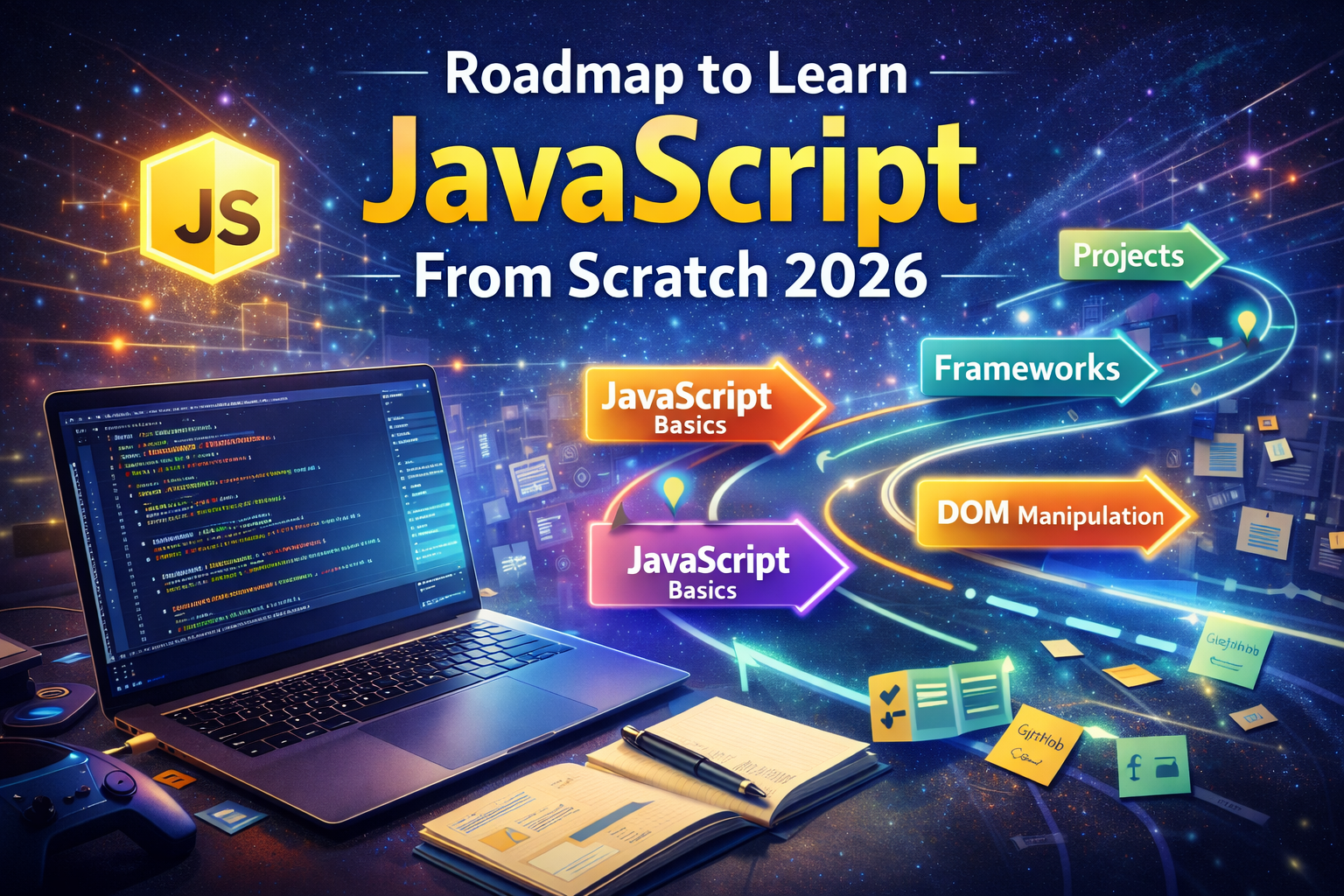
JavaScript powers almost every modern website today. However, many beginners feel confused about where to start. Consequently, they jump between tutorials and waste time.
A clear Roadmap to learn JavaScript from scratch 2026 solves this problem. Additionally, it helps you move step by step without missing fundamentals. This guide gives you a practical plan, simple tools, and realistic milestones so you can become job ready faster.
Roadmap to learn JavaScript from scratch 2026: Step by Step Plan
Think of learning JavaScript like building a house. First, you lay the foundation. Then, you add walls and features. Similarly, you must master basics before frameworks.
Follow this order carefully:
- Learn HTML and CSS basics first
- Master core JavaScript fundamentals
- Build projects before moving to frameworks
Consequently, you avoid confusion and understand how everything connects.
Step 1: Understand Web Basics First
Before touching JavaScript deeply, you must know how the web works. Browsers read HTML for structure and CSS for design. JavaScript adds behavior. Therefore, skipping these basics creates gaps later.
Start with simple pages. Additionally, practice headings, forms, and layouts. Consequently, you will understand how JavaScript manipulates elements on the screen.
Spend one or two weeks here. However, do not aim for perfection. Just understand the flow.
Step 2: Learn Core JavaScript Fundamentals
Now move to the heart of coding. Focus only on pure JavaScript at first. Avoid frameworks early because they hide important logic.
Start with variables, data types, and operators. Then learn loops and conditions. Additionally, practice functions and arrays daily. Consequently, problem solving becomes easier.
Key concepts you must master:
- Variables, scope, and data types
- Functions, arrays, and objects
- DOM manipulation and events
Practice small exercises regularly. Therefore, your memory improves through repetition.
Step 3: Work With the Browser and DOM
JavaScript becomes exciting when you control the page. The Document Object Model allows you to change text, styles, and behavior instantly. Consequently, you see results quickly.
Learn how to select elements and handle clicks. Additionally, create forms and validations. As a result, you build real interactive apps.
Use browser developer tools daily. However, avoid copying code blindly. Try writing everything yourself first.
Step 4: Modern JavaScript and ES6 Features
Once you feel confident, move to modern syntax. New features make code shorter and cleaner. Therefore, employers expect this knowledge.
Learn arrow functions, destructuring, and modules. Additionally, understand promises and async code. Consequently, you can handle APIs and real data.
This stage connects theory to real world development. So, build mini apps like weather tools or to do lists.
Step 5: Projects and Version Control
Projects turn knowledge into skills. However, many learners skip this step. Consequently, they struggle in interviews.
Build practical apps regularly. For example, create a calculator, quiz app, or small dashboard. Additionally, upload every project to GitHub.
Useful project ideas include:
- To do list with local storage
- Weather app using public API
- Simple expense tracker
These projects show recruiters your abilities clearly. Therefore, they improve your chances of getting hired.
Step 6: Frameworks and Career Direction
After mastering core JavaScript, choose a framework. React remains very popular. Additionally, many companies use Angular and Vue. Pick one and go deep instead of learning all.
Understand components, state, and routing. Consequently, you can build full applications. Also, learn basic backend skills like Node.js for better opportunities.
Keep practicing algorithms and problem solving. However, balance learning with building real products.
Common Mistakes to Avoid
Many beginners repeat the same errors. However, you can avoid them easily with awareness.
Do not jump between courses daily. Additionally, do not memorize without coding. Consequently, progress becomes slow.
Stay consistent for at least one hour each day. Small steps compound into big results.
Conclusion
Learning JavaScript in 2026 is easier than ever. Resources are everywhere. However, structure matters more than quantity.
If you follow this Roadmap to learn JavaScript from scratch 2026, you will build strong fundamentals and real projects. Additionally, you will gain confidence for interviews and freelance work. Stay patient, code daily, and treat mistakes as lessons.
Frequently Asked Questions
1. How long does it take to learn JavaScript from scratch?
Most beginners become comfortable in three to six months with daily practice.
2. Should I learn React or Angular first?
Start with core JavaScript first. Then choose one framework based on job demand in your area.
3. Do I need a computer science degree to get a job?
No. Strong projects, GitHub work, and practical skills matter more than formal degrees.
Other Articles

What Should Countries Focus on to Stay Ahead in 2026 for Growth?
What Are the Top Upcoming Games in 2026 Every Gamer Should Watch?